
Western Palmistry — Palm Lines Series
Of the three major lines on the human palm, none attracts more curiosity than the heart line. It sits closest to the fingers, it’s usually the first line people ask about, and it deals with the subject we all care most about: love. But the heart line is far richer than “long means romantic.” In this guide, we go deeper — into its history, its many variations, and the rare formations most casual readers miss.
A Line With Ancient Roots
Palmistry — formally called chiromancy — is one of humanity’s oldest character-reading traditions. Most historians trace its origins to ancient India, from where it traveled to China, Persia, Egypt, and eventually ancient Greece. In Renaissance Europe, chiromancy manuals treated the palm like a map: scholars of the era correlated the three main lines with the body’s principal organs — the heart, the brain, and the liver. The line beneath the fingers belonged to the heart, and it has carried that association ever since.
The tradition was revived in the 19th century by famous practitioners like the Irish palmist Cheiro and the American William Benham, whose systems still shape how Western palmists read the heart line today.
Finding Your Heart Line
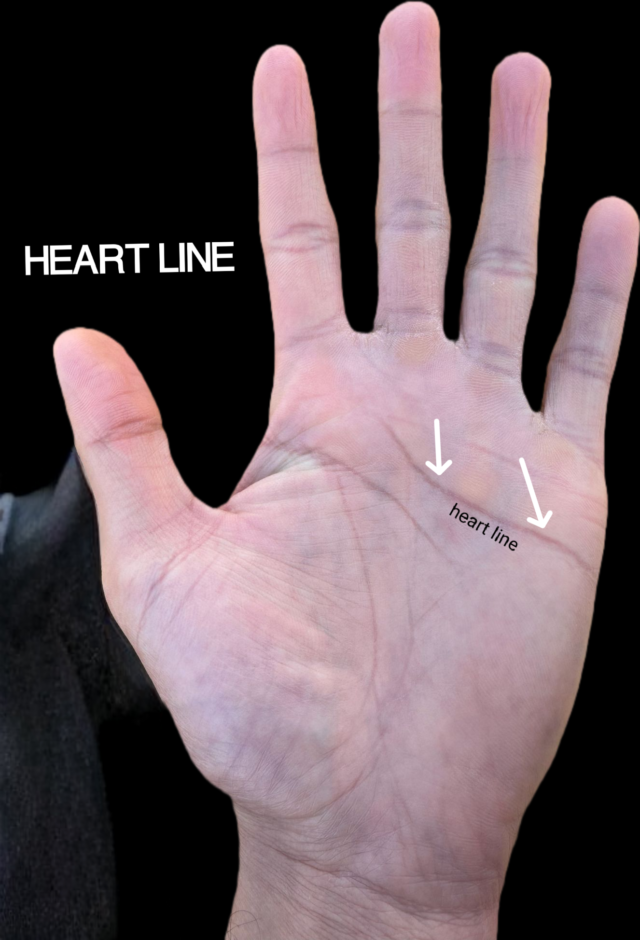
Open your palm. The heart line is the topmost horizontal crease, beginning at the edge of the palm under your little finger and traveling across toward your index or middle finger. The line just below it is the head line — don’t mix them up. Read your dominant hand first: in Western tradition it reflects your present, conscious self, while the other hand is said to show inherited tendencies — the emotional nature you were born with. Comparing the two is where the most interesting readings happen.
Length: How Much of You Does Love Occupy?
Long heart line (reaching the index finger or crossing the full palm): traditionally read as a deeply emotional nature. These are people who invest heavily in relationships, crave closeness, and often idealize the ones they love. Their risk: giving so much that they lose themselves.
Medium heart line (ending between the index and middle fingers): the classic balanced heart — empathetic and warm, but with healthy boundaries. Many palmists consider this the most harmonious length.
Short heart line (ending under the middle finger or earlier): a reserved, self-contained emotional style. Traditionally linked to people who approach love practically and privately. They are not cold — they simply show love through reliability and action rather than declarations.
Where the Line Ends
The termination point refines the reading:
Under the index finger (Mount of Jupiter): the idealist. High standards, deep devotion, and a tendency to put partners on pedestals. Sensitive to how others perceive them.
Under the middle finger (Mount of Saturn): the self-directed lover. Traditionally read as someone guided more by personal desire than sentiment — independent in love, sometimes to the point of seeming detached.
Between the two: emotional balance — heart and head negotiating as equals.
Curved vs. Straight
A curved heart line, arching upward toward the fingers, is the mark of the expressive lover: warm, demonstrative, and quick to form bonds. These are the initiators — the ones who say “I love you” first.
A straight heart line, running flat across the palm, belongs to the quiet processors. They think before they feel out loud. Their affection is steady, controlled, and often expressed through loyalty rather than grand gestures.
Depth matters too: a deep, clearly etched line is traditionally a sign of emotional clarity and confidence, while a faint or wavy line suggests a heart still finding its footing.
The Markings: Chains, Islands, Breaks, and Forks
Experienced palmists spend as much time on the texture of the line as its shape:
Chains — a linked, braided appearance — traditionally signal emotional sensitivity and turbulence: a heart easily hurt, easily moved, and shaped by its ups and downs.
Islands — small enclosed loops — are read as periods of emotional confusion or divided feelings.
Breaks in the line are the most misunderstood marking. In traditional reading, a break is not a doomed relationship — it’s an emotional turning point: a moment where the way you love changed, often through loss followed by growth.
A fork at the end is one of the luckiest signs on the heart line. It’s read as the ability to balance emotion with reason — someone who loves deeply and wisely. A three-pronged fork is traditionally linked to charm, popularity, and emotional flexibility.
Branches carry direction-based meaning: upward branches are read as optimism and happy attachments; downward branches as disappointments the heart has had to absorb.
The Rare One: The Simian Line
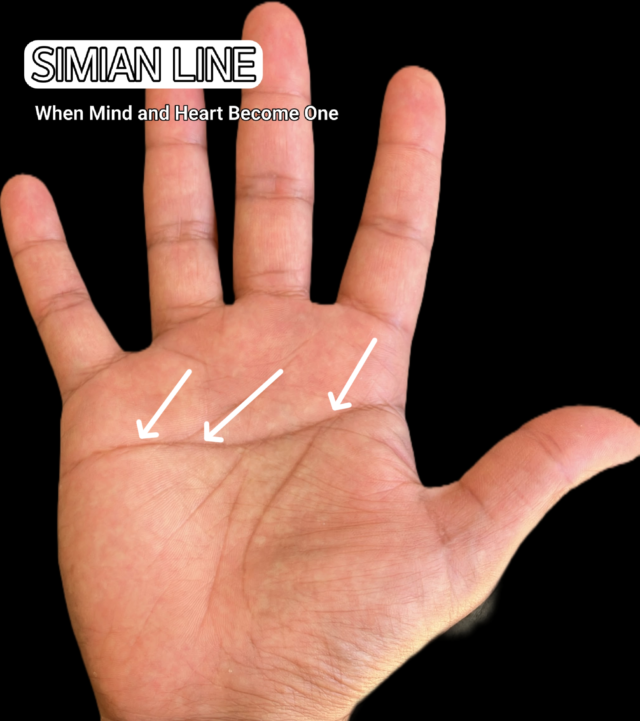
In roughly 1 in 10 people on one hand — and far fewer on both — the heart line and head line merge into a single crease running straight across the palm. This is the famous simian line (also called the single transverse palmar crease, or in Indian palmistry, Kapi Rekha).
Palmists read this fusion as emotion and intellect operating as one force. The result is intensity: all-or-nothing focus, fierce commitment, and remarkable determination — but also difficulty separating what one feels from what one thinks. Traditionally, it is considered neither lucky nor unlucky; it is simply concentrated. Many notably driven and successful people carry it.
Reading It Responsibly
Two things every honest palmist tells you. First, the heart line is a tool for self-reflection, not prediction — a mirror for noticing your own emotional patterns, not a sentence handed down. Second, despite the old Renaissance link between this line and the physical heart, no palm line is a medical indicator. Health questions belong with a doctor, always.
It’s also worth knowing that lines are not fixed. Palmists have long observed that creases subtly change over a lifetime — which the tradition takes as its most hopeful teaching: the way you love is not carved in stone.
Now Check Your Palm
So look down at your hand. Is your heart line long or short? Curved or straight? Is there a fork at its end — or is it fused with your head line into a single rare crease?
Compare both hands, then tell us what you found in the comments. And if you missed our earlier posts on the wider and narrow life line, go to westernpalmistry handle on Instagram — your palm’s full story needs all three lines.
Coming next in the series: The Head Line — how your palm maps the way you think.
Western Palmistry shares traditional interpretations for reflection and entertainment. Palm lines are not medical or psychological diagnoses.
