
Western Palmistry — Palm Lines Series
You’ve read your heart line. You know how you love. Now look one line lower — at the crease running horizontally through the middle of your palm. This is the head line, and in palmistry it is read as the map of your mind: how you reason, how you decide, whether you lean toward cold logic or wild imagination, and how your thinking has changed over the course of your life.
Palmists sometimes call it the line of wisdom or the line of thought, and many consider it the most revealing line on the entire hand — because while the heart line shows what you feel, the head line shows what you do with it.
___________________________________________________________________________
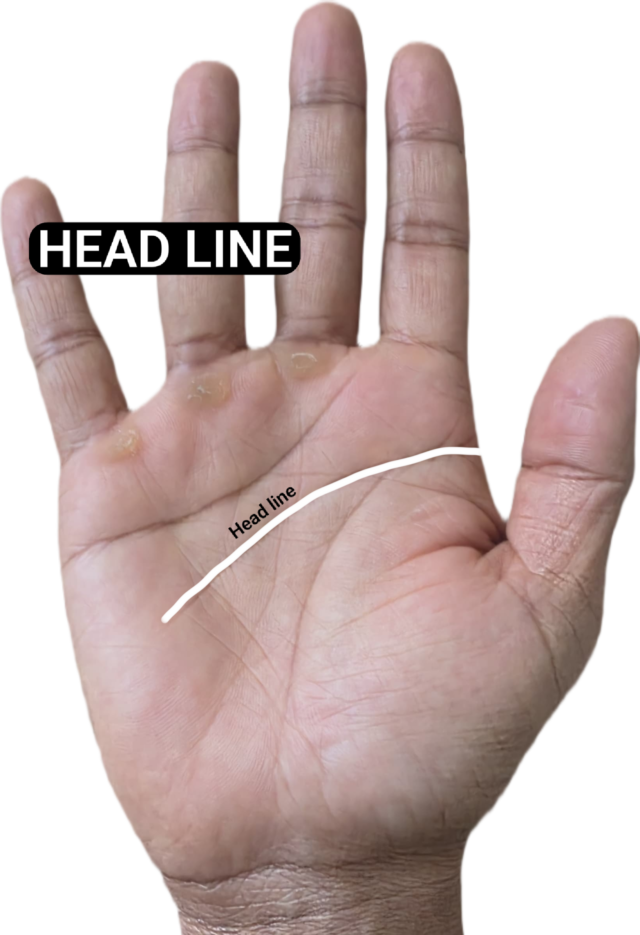
Finding Your Head Line
Open your palm. The head line begins at the edge of the palm between your thumb and index finger — very close to where the life line starts — and travels horizontally across the middle of the hand. It sits just below the heart line. If you only see one horizontal crease instead of two, you may have the rare simian line, which we covered in our heart line article.
As always, read your dominant hand first for your present thinking style, then compare it with your other hand, which tradition says shows the mind you were born with. When the two differ — say, a straight line on one hand and a sloping one on the other — palmists read it as a mind that has grown in a new direction over time.
First, Let’s Kill the Biggest Myth
A short head line does not mean low intelligence. This is the single most common misreading in palmistry, and traditional palmists reject it outright. Length is read as thinking style, not thinking power:
A long head line — stretching toward the far edge of the palm under the little finger — is read as the deep processor. Analytical, detail-hungry, thorough. These minds want to understand things fully before acting. Their shadow side: overthinking, and building mental walls that are hard to climb back out of.
A short head line — ending around the middle of the palm — is read as the fast processor. Decisive, instinct-driven, practical. These are minds built for action, common among entrepreneurs and leaders who trust their gut and move. Their shadow side: impatience with long deliberation.
Same intelligence. Different operating systems.
Straight or Sloping: Logic vs. Imagination
The direction of the line is where the reading gets personal.
A straight head line, running level across the palm, is the mark of the realist: structured, disciplined, and analytical. Traditionally linked to people who thrive in fields built on precision — engineering, finance, science, law.
A sloping (curved) head line, dipping downward toward the fleshy outer base of the palm — the Mount of Luna, palmistry’s seat of imagination — belongs to the dreamer. Intuitive, creative, guided by inner vision. Writers, artists, and poets are traditionally said to carry this line. The steeper the slope, the richer the imagination — and, tradition warns, the greater the emotional sensitivity that comes with it.
Most hands fall somewhere between: a gentle curve, a mind that can do both.
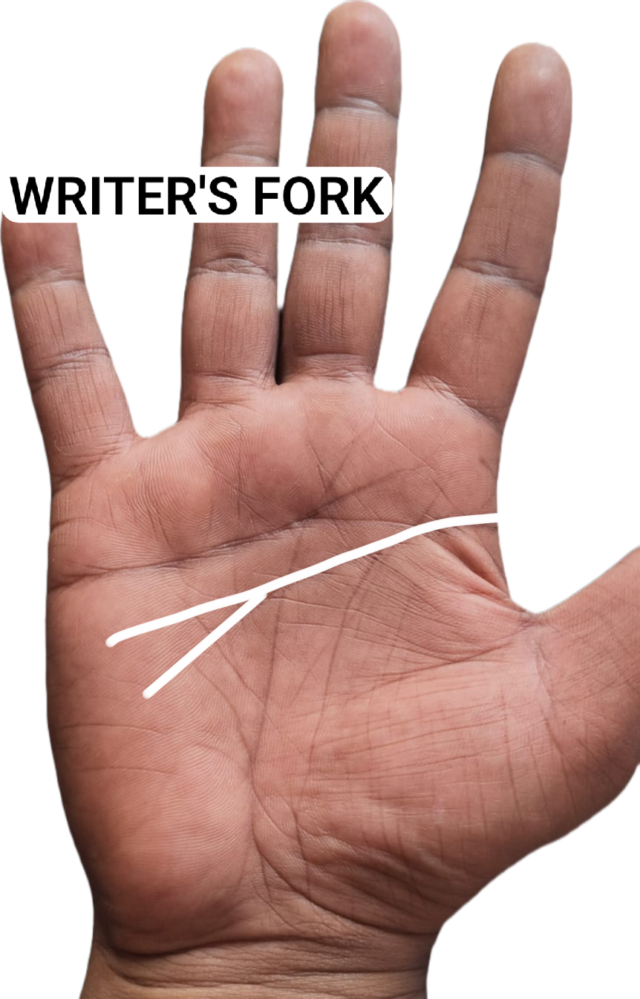
The Writer’s Fork: Palmistry’s Most Coveted Marking
Look at the very end of your head line. In some hands, instead of stopping at a single point, it splits into a small Y shape — one branch running straight, the other dipping toward the Mount of Luna.
This is the famous writer’s fork, and it is one of the most sought-after signs in all of palmistry. The reading: a bridge between the analytical mind and the imaginative one — the rare ability to take inner vision and turn it into something real: words, designs, plans, art. It’s traditionally associated with writers, journalists, diplomats, and anyone whose gift is translating ideas into form.
If the fork is very large — almost like two separate head lines — palmists read a dual nature: the accountant who’s secretly a musician, the farmer who designs, the artist with a business mind.
Joined to the Life Line, or Free of It?
Check where your head line begins:
Joined to the life line at the start: a cautious, considered thinker. Tradition links this to a mind shaped strongly by family and early upbringing — someone who weighs risks and values security before leaping.
Starting separate, with a clear gap: the independent spirit. Quick to form their own views, comfortable going against the grain, sometimes impulsive. The wider the gap, the bolder the mind.
The Markings
Depth: a deep, clearly carved line is read as focus, strong memory, and mental stamina; a faint line as a sensitive, flexible mind still gathering its confidence.
A wavy line is read as the versatile-but-restless thinker — many interests, shifting focus. Not a flaw; an adaptability.
Islands and chains traditionally mark periods of mental strain, divided attention, or decisions that pulled the mind in two directions.
Breaks are read the same way as on the heart line: not damage, but transformation — a moment your entire way of seeing the world changed, often around a major life shift.
Branches: upward shoots are read as optimism and constructive ambition; downward ones as seasons of doubt or deep, heavy reflection.
Four Thinking Archetypes
Putting it together, palmists often sort head lines into four broad characters. See which one is yours:
The Analyst — long and straight: precise, logical, exhaustive.
The Doer — short and bold: fast, practical, decisive.
The Dreamer — long and sloping: intuitive, artistic, inward.
The Bridge — forked at the end: the translator between imagination and reality.
Reading It Honestly
The same disclaimer we gave for the heart line applies here, doubled. Palmistry is a centuries-old tradition of self-reflection, not a scientific measure of cognition — no line on your hand fixes your intelligence, your career, or your potential. Its real value is the question it makes you ask: does this description fit the way I actually think? That question, honestly answered, is worth more than any prediction.
Now Check Your Palm
Is your head line long or short? Straight or sloping? Is there a writer’s fork hiding at its end? Does it start joined to your life line, or does it stand free?
Check both hands, compare them, and tell us your combination in the comments. And if you’re just joining the series, catch up on the heart line, the wider life line, and the narrow life line — one line left, and your palm’s full story will be complete.
Coming next in the series: The Fate Line — the vertical line of career, purpose, and path.
___________________________________________________________________________
Western Palmistry shares traditional interpretations for reflection and entertainment. Palm lines are not medical or psychological diagnoses.
