
 Every other mount on your hand improves by being bigger.
Not this one.
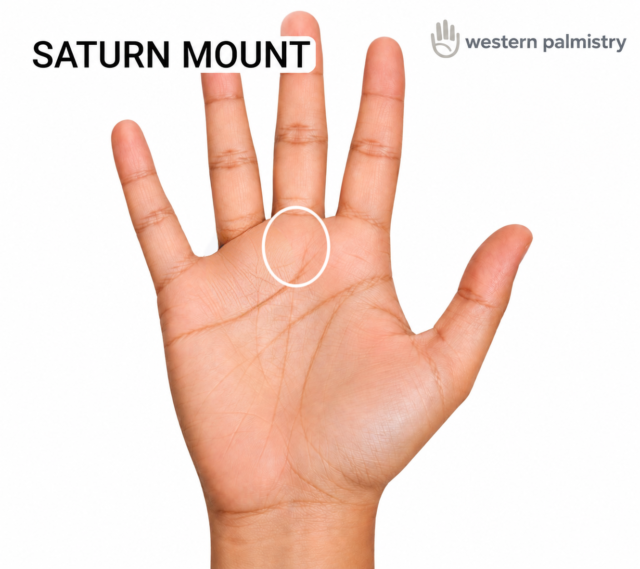
The Mount of Saturn sits under your middle finger, and it’s the odd one out in palmistry. A big Jupiter mount is confidence. A big Apollo mount is charm. A big Saturn mount is… a lot. Gloom, suspicion, a mind that circles the drain at 3am.
Benham, who wrote the most careful book we have on Western palmistry, called Saturn the balance wheel of the hand. That’s exactly right. You want enough of it to keep everything steady. You don’t want it running the machine.
So the ideal Saturn is modest. Present, but not the loudest thing in the room.
Let me show you how to read yours.
___________________________________________________________________________
What Saturn Actually Governs
Before you look, know what you’re looking for. Saturn rules the serious, slow, load-bearing parts of a person:
Patience. Study. Solitude. Caution. Responsibility. The ability to endure something unpleasant because it matters. A sense of consequence, and of time passing.
These are genuinely good qualities. Saturn is the reason some people finish the hard thing. But turn the dial too far and the same traits curdle into pessimism, isolation, and joylessness.
That’s the whole reading in one sentence: Saturn is ballast, and ballast is only useful in the right quantity.
___________________________________________________________________________
Step One: How Developed Is It?
Palm up, good light. Press the cushion under your middle finger.
Slightly raised, or nearly flat. This is the good news finding, even though it doesn’t look impressive. You have ballast without being weighed down. Most well-balanced hands look like this.
Clearly full and firm. Strong Saturn qualities. Serious, private, disciplined, probably happier alone than most people realise. This isn’t bad — a lot of scholars, researchers, and craftspeople have this hand. Just know that it comes with a pull toward solitude you’ll need to manage on purpose.
Very high and prominent. The heavy version. The old texts don’t mince words here: melancholy, suspicion, a tendency to expect the worst and be unsurprised when it arrives. If this is you, the reading isn’t a sentence — it’s a warning about where your mind defaults when you’re not watching it.
Completely flat, with no ballast anywhere on the hand. Rare, and not the win people assume. This can point to someone with no staying power, no patience for consequence, chasing the next thing forever.
___________________________________________________________________________
Step Two: Where Does It Lean?
Look at the fine skin ridges on the mount under strong light. They gather toward a point. Where that point sits changes the reading a lot — this is the detail most guides skip.
Centred under the middle finger. Saturn straight up. Serious, self-contained.
Leaning toward the index finger (Jupiter). Good news. Ambition lightens the seriousness. This person’s discipline has somewhere to go.
Leaning toward the ring finger (Apollo). The most fortunate placement, traditionally. Art, beauty, and warmth soften Saturn’s edges. The disciplined person who also knows how to enjoy something.
I’ll say plainly: whenever I find Saturn leaning toward Apollo, I relax about everything else on the mount.
___________________________________________________________________________
Step Three: The Middle Finger
Your middle finger should be the longest. That’s normal. What matters is how much longest.
Noticeably longer than everything else — Saturn is dominant. Heavy, cautious, prone to brooding.
Barely longer, almost level with the others — light on caution. Impulsive, allergic to consequences, often good fun and occasionally a menace to their own bank account.
Which section is thickest? Top section longest points to a philosophical or spiritual bent. Middle section points to science, research, and method. Bottom section, nearest the palm, points traditionally to land, property, and material things — and to a streak of thrift that can tip into miserliness.
___________________________________________________________________________
The Good Signs
A triangle. The best mark on this mount, and a genuinely encouraging one. It points to real aptitude for deep study — science, research, or the esoteric. The person who can sit with a difficult subject for years. If you have this and you’ve been sitting on some long project, take it as a nudge.
A single clear vertical line running up the mount. Focus and direction. One strong line is worth more than a dozen faint ones.
A square. Protection. Something difficult passed through without doing lasting damage. On Saturn, this is a reassuring find, especially near a break or a troubled patch.
___________________________________________________________________________
The Difficult Signs
Read these as weather, not verdicts. I mean that literally, and I’ll explain why at the end.
A grille — a tight crisscross mesh. Saturn’s classic caution mark. Traditionally read as misfortune and gloom. I read it as seriousness with no outlet — the mind grinding on itself because it hasn’t been given a proper problem to chew.
A cross. Here’s a useful contrast: on the Jupiter mount, a cross is good news, pointing to a happy partnership. On Saturn, the tradition reverses it and reads a cross as a mark of hardship or fatalism. Worth knowing, because most people assume all crosses mean the same thing.
An island — a small oval gap in a line. A period of divided or blocked energy.
The Ring of Saturn. A curved line arcing across the base of the middle finger, cutting the mount off from the rest of the hand. Classically one of the least welcome marks in palmistry: it’s said to wall Saturn in, blocking the steadiness from reaching everything else. The traditional reading is isolation and difficulty seeing things through.
Don’t confuse it with the Ring of Solomon, which arcs around the index finger and is a very good mark. Same shape, one finger apart, opposite meanings. This trips up nearly everyone.
___________________________________________________________________________
What I’ve Come to Think
Here’s my own view rather than the textbook one, so weigh it as one practitioner’s pattern.
The old books treat Saturn’s difficult marks as signs of a gloomy nature. I don’t read them that way anymore.
In hand after hand, the people with heavy Saturn markings weren’t melancholy by temperament. They were serious people who hadn’t been given anything serious enough to do. Saturn’s capacity is enormous — it’s the mount of endurance, depth, and the long haul. When it has a worthy problem, it’s magnificent. When it doesn’t, it turns that capacity inward and starts examining the person who owns it.
So when I find a grille on Saturn, I don’t say “you’re prone to sadness.” I ask what they’re working on. The answer is usually “nothing, really” — and that’s the actual finding.
___________________________________________________________________________
Read Yours in Five Minutes
- Press the mount. Slight, full, very high, or flat?
- Find the lean. Toward Jupiter, toward Apollo, or straight up?
- Check the middle finger. How much longer than the others?
- Look for the good marks first. Always. Triangle, clear line, square.
- Then the difficult ones. Grille, cross, island, ring.
- Compare both hands. The hand you don’t write with is what you were given. The one you write with is what you’ve made of it. A Saturn that has lightened between hands means you’ve built a life with some joy in it. That’s a real finding, and a lovely one.
___________________________________________________________________________
Palmistry is a symbolic tradition, not a science. Nothing here predicts the future, diagnoses illness, or limits what you’re capable of. For health, money, or legal matters, please talk to a qualified professional.
