
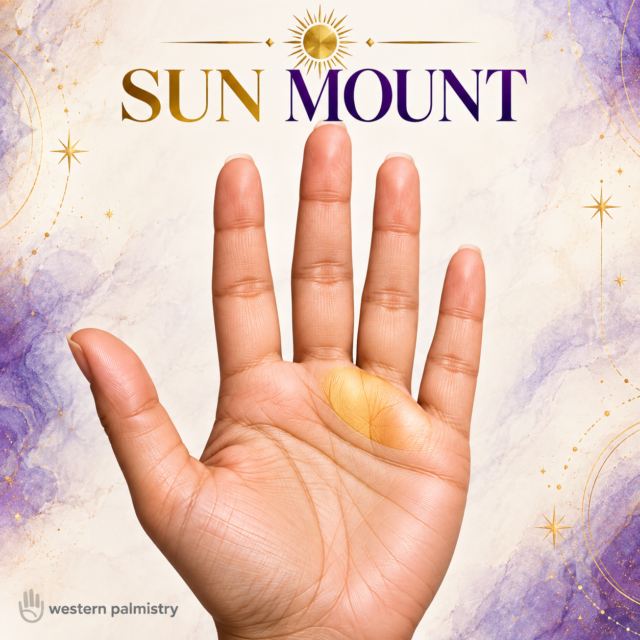
Look at the little cushion under your ring finger.
That’s the Mount of the Sun — also called the Mount of Apollo — and if the Jupiter mount is about how much you want and the Saturn mount is about how much you can carry, this one is about something simpler and harder to fake.
How much light you let in.
Joy. Warmth. Creativity. The pleasure you take in a beautiful thing. Whether you can enjoy success when it arrives, or just move the goalposts. The old palmists also called it the mount of fortune and fame, and there’s something to that. But in my experience it’s less about whether the world notices you and more about whether you notice what’s good.
Let me show you how to read it.
___________________________________________________________________________
Step One: Full, Flat, or Too Much?
Palm up, good light. Press the cushion beneath your ring finger.
Nicely full and firm. The warm hand. Charm, creative instinct, a real eye for beauty, and — this matters — the ability to enjoy things without guilt. People tend to like being around this person, and usually can’t say why.
Flat. Not a bad sign, whatever you’ve read elsewhere. It points to someone practical and grounded, who doesn’t need beauty or applause to feel steady. The risk is that life turns a little dry. Everything useful, nothing delightful. If that rings true, the fix is often embarrassingly simple: make room for one thing you do purely because you love it.
Very puffy and prominent. The sun turned up too high. Traditionally this is vanity, love of display, extravagance, and a need for an audience that no audience can satisfy. The person who is dazzling at parties and quietly exhausting to live with.
___________________________________________________________________________
Step Two: Which Way Does It Lean?
Look at the fine skin ridges on the mount under strong light. They gather toward a point, and where that point sits changes the reading.
Centred under the ring finger. Apollo straight up. Creativity and warmth, expressed for their own sake.
Leaning toward the middle finger (Saturn). Art with depth. The disciplined creative — someone whose talent is backed by patience and serious work. Often slower to succeed, and much harder to knock over once they do.
Leaning toward the little finger (Mercury). Talent with a business brain. This is the designer who can sell, the performer who understands the audience, the writer who hits deadlines. Traditionally one of the most profitable placements on the hand.
___________________________________________________________________________
Step Three: The Ring Finger
Now compare your ring finger to your index finger.
About the same length. Balance between ambition (index) and enjoyment (ring).
Ring finger noticeably longer. Creative, expressive, and — Cheiro was blunt about this — with a streak of the gambler. This person trusts luck, takes chances, and often has a flair for risk that pays off right up until it doesn’t.
Ring finger much longer, nearly matching the middle finger. The streak gets stronger. Brilliant instincts, and a real need to watch the spending and the bets.
Ring finger short. Less need for recognition. Quieter creativity, or creativity that shows up in unexpected places — the garden, the kitchen, how someone arranges a room.
Which section is longest? A long top section suggests artistic ideals and taste. A strong middle section points to turning talent into something real and practical. A thick bottom section, nearest the palm, points to love of luxury, comfort, and beautiful things — lovely in moderation, costly without it.
___________________________________________________________________________
The Good Signs
One clear vertical line. The best thing you can find here. It’s the Sun Line arriving on its home mount — talent with a clean channel to the world. One strong line beats several faint ones every time. (If you want to go deeper on that line, I’ve written a whole post on the Sun Line.)
A star. The classic sign of brilliant success and public recognition. Be strict: three or more lines crossing at one point. The old books add a caution, and I agree with it — a star here is a big moment, but a big moment isn’t the same as a contented life. Look at the rest of the hand before celebrating.
A triangle. My favourite mark on this mount. It means talent put to practical use — success without vanity, creativity with its feet on the ground.
A square. Protection. Reputation or creative work survives a bad patch.
A trident — a single line splitting into three prongs at the top. Traditionally one of the luckiest endings in palmistry: success, money, and recognition together. I read it more modestly as a talent that found more than one door.
___________________________________________________________________________
The Difficult Signs
Weather, not verdicts.
A grille — a tight crisscross mesh. Apollo’s classic warning. Traditionally vanity and a craving for attention. I read it as creative energy with nowhere to go, turning into performance instead of work.
A cross. On this mount, traditionally a disappointment in creative or financial hopes. Notice how crosses change meaning depending on where they sit — good news on Jupiter, hard news on Saturn and here.
An island. Traditionally a stretch where reputation took a knock. I read it as a period of doing good work under someone else’s name or shadow.
Lots of scattered fine lines. Many talents, no single one developed. This is incredibly common among genuinely gifted people. The answer is almost always: pick one, and give it a few years.
___________________________________________________________________________
What I’ve Come to Believe
My own view here, not the textbook’s, so weigh it accordingly.
The old books treat a flat Sun mount as a missing gift — no talent, no luck, no shine. I’ve stopped believing that.
In hand after hand, the flat Apollo mounts I’ve seen didn’t belong to people without creativity. They belonged to people who’d never given themselves permission to enjoy anything that wasn’t useful. The capacity was there. It just hadn’t been allowed out.
And interestingly, the Sun mount is one of the areas where I’ve watched hands change the most. People start painting at fifty, or singing again, or simply stop apologising for liking what they like — and the mount responds.
___________________________________________________________________________
Read Yours in Five Minutes
- Press the mount. Full, flat, or puffy?
- Find the lean. Toward Saturn, toward Mercury, or centred?
- Compare the ring finger with the index. Longer, shorter, level?
- Find the good marks first. Always start with what’s working.
- Then the difficult ones.
- Compare both hands. The hand you don’t write with shows what you were given. The one you write with shows what you’ve done with it. If your Sun mount is fuller on your writing hand, you’ve let more joy into your life than you started with. That’s worth knowing, and worth protecting.
___________________________________________________________________________
Before You Go
If you’ve just discovered a flat Sun mount and a short ring finger and felt a little deflated — please don’t.
Nothing on your palm decides whether you’re creative, whether you’ll be lucky, or whether good things are coming. Palmistry is a way of asking better questions, not a list of what you’ve been allotted.
And this mount asks one of the best questions in the whole hand:
When did you last do something just because it made you happy?
If the answer takes a while to arrive — that’s the reading.
___________________________________________________________________________
Palmistry is a symbolic tradition, not a science. Nothing here predicts the future, diagnoses illness, or limits what you’re capable of. For health, money, or legal matters, please talk to a qualified professional.
