
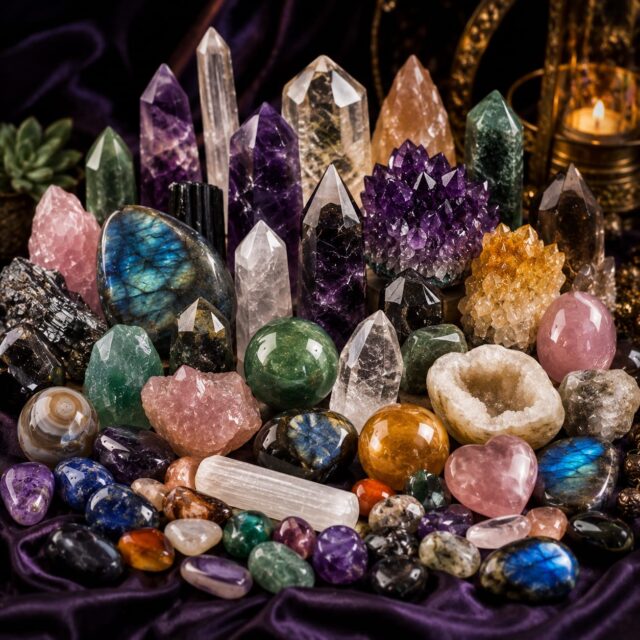
There’s a reason so many people who feel drawn to the stars and the lines of the palm feel drawn to stones as well. All three are ways of slowing down and paying attention — of treating the world as something that speaks, if you’re willing to listen. Crystals belong in that same quiet family. They ask you to hold something, to notice it, to let it become a small anchor for your intention.
Over the coming weeks, I’ll be taking crystals one at a time on this blog — a single stone in each post, its story and its meaning, so you can get to know them the way you’d get to know old friends. Before that series begins, though, I want to lay a little groundwork here, so that everything after this has a foundation to rest on. Think of this as the doorway, not the whole house.
What a crystal actually is
It’s worth knowing what you’re really holding, because the truth is more wonderful than most people realize. A crystal is a solid whose atoms are arranged in a repeating, orderly pattern — the same tiny arrangement, echoed over and over, sometimes billions of times. That inner order is what gives a quartz point its clean geometric faces: the flat planes you see on the outside are a direct expression of how the atoms are stacked within. The shape isn’t decoration. It’s the stone being honest about what it is.
Most crystals form slowly — cooling from molten rock deep underground, or growing grain by grain out of mineral-rich water seeping through the earth, the way frost feathers across a window. The colors come from real chemistry too: a whisper of iron turns quartz purple and gives us amethyst; other trace minerals bring the blush to rose quartz or the gold to citrine. When a stone spent an unimaginable stretch of time assembling itself inside the earth and now rests in your palm, that alone is something to sit with.
How crystals have long been used
Long before anyone spoke of geology, people kept stones close for meaning. Across many traditions, crystals have been carried, worn, and placed with intention — as reminders, as focuses for reflection, as companions to ritual. In the language of correspondences that practitioners still use today, particular stones are paired with particular qualities: some for grounding, some for clarity, some for opening the heart. Many readers like to pair a stone with their sun sign or with the element that rules it — earth, water, air, or fire — as a way of choosing one that feels like theirs.
I’ll share these traditional associations throughout the series, and I’ll always share them as what they are: an inherited language of meaning, rich and beautiful, gathered over centuries. You don’t have to take any of it as literal machinery to find it worth using. A symbol becomes powerful the moment you decide to work with it — the same way a card in a spread or a placement in a chart becomes a doorway into reflection. The stone gives your attention somewhere to land.
Holding them gently
Here’s the spirit I’d invite you to bring to all of this, and it’s the same one I bring to a reading. Crystals are companions for reflection, intention, and calm — a way to steady yourself, mark a moment, or return to something you want to remember. Held that way, they can genuinely enrich a practice. What they aren’t is a substitute for medical or professional care. If something in your body or your life needs a doctor, a stone is a lovely companion for the journey but never a replacement for the help itself. Keeping that clear isn’t a limit on the magic — it’s what lets you enjoy the magic freely, without asking a piece of quartz to carry a weight it was never meant to hold.
That, to me, is the difference between using crystals well and being let down by them. Choose them for meaning, for beauty, for the pause they invite — and they’ll rarely disappoint you.
Choosing a stone that’s yours
People often ask how to pick a crystal, expecting a chart or a rule. My honest answer is simpler: choose the one you keep looking back at. The color that catches you, the weight that feels right in your hand, the one you find yourself reaching for. Your attention is already telling you something. Trust it. As the series goes on and you learn each stone’s traditional character, you’ll have language to add to that instinct — but the instinct comes first.
What’s coming in this series
Here’s a taste of the stones I’ll be exploring, one post at a time:
Clear Quartz — the open, uncomplicated one, long treated as a blank page for intention.
Amethyst — the deep purple stone of calm and reflection, and a favorite for quiet.
Rose Quartz — soft and pink, traditionally the stone of the open heart.
Citrine — warm and golden, carried for brightness and a sense of possibility.
Selenite — luminous and satiny, associated with clarity and gentle light.
And several more, chosen for their beauty and their stories.
I’ll link each one here as it’s published, so this post can grow into a little library you can return to.
(Links to each crystal post will go here as they go live.)
Lapis Lazuli: The Stone That Painted Heaven – Western Palmistry https://westernpalmistry.com/lapis-lazuli-the-stone-that-painted-heaven/
So consider this the doorway. Next time, we’ll step through it and begin with our first stone. Until then, if you already have a crystal nearby, pick it up for a moment — really look at it — and notice what it stirs. That noticing is where all of this begins.
