
Western Palmistry — Palm Lines Series
Everyone who learns a little palmistry ends up doing the same thing: flipping their hand sideways, squinting at the edge below the pinky, and counting the tiny lines there. Because those little lines are the ones that supposedly hold the answer to the question we all secretly want answered — what happens to my love life?
These are the relationship lines — often called affection lines, and traditionally (and misleadingly) the “marriage lines.” They’re the most whispered-about, most misread lines on the whole hand. So let’s set the record straight — with real tradition behind it, not fortune-cookie guesses.
___________________________________________________________________________
First, Forget the Old Name
You’ll see these called “marriage lines” all over the internet — but that 100-year-old label causes more panic than any other term in palmistry, because it promises something a line simply can’t. So let’s be clear from the start: these lines don’t necessarily indicate legal marriages. That’s why modern palmists call them relationship lines or affection lines — and those are the names we’ll use here. They read the deep bonds that shape you — the great loves, the partnerships that change you — whether or not a certificate was ever involved.
One line does not mean one wedding. It means one bond that left its mark.
Where to Find Them
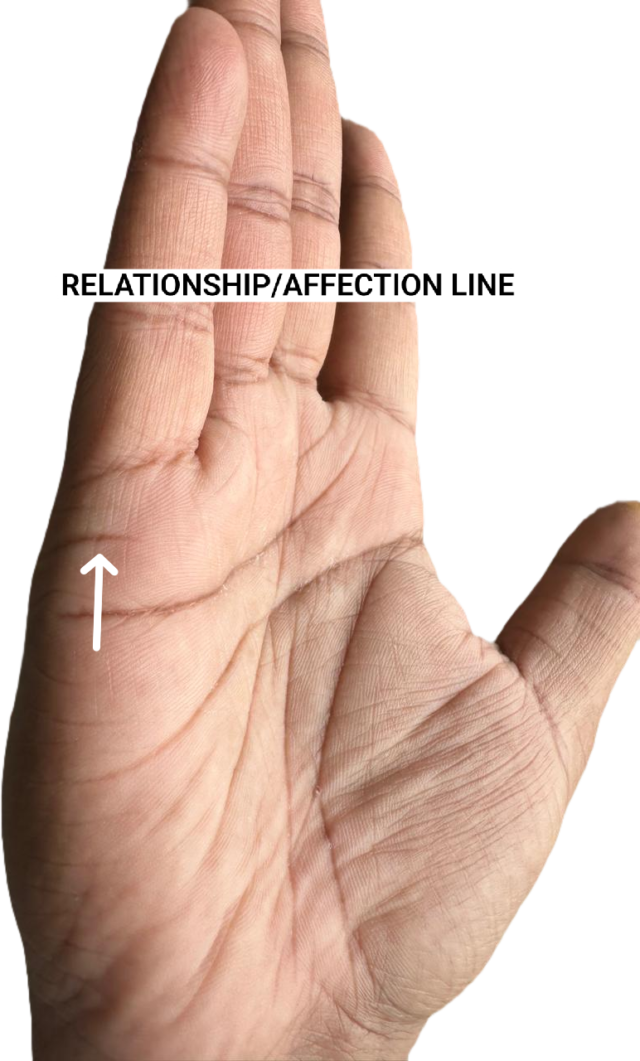
Turn your palm to face you and look at the outer edge below your little finger. The relationship lines are short horizontal lines beneath the root of the pinky and above the heart line, on the area palmists call the Mount of Mercury — the same mount tied to communication and connection. They run horizontally from the edge of the palm inward toward the center.
Read your dominant hand as your active, present love life. Compare it with your other hand for the emotional patterns you were born with — the contrast between the two is often the most revealing part of the whole reading.
How Many Lines Do You Have?
This is the number everyone counts first, so let’s handle it honestly. Most people have one to three lines, though some have more or fewer. And here’s the truth the old books buried: the count carries no moral weight.
Multiple lines aren’t a sign of fickleness or failure. They’re a record of emotional depth — evidence that you’ve offered yourself fully to connection more than once, which takes courage and resilience. Equally, a single line doesn’t mean rigidity; it suggests focus, a channeling of relational energy into one current.
So whether your palm shows one clean line or a little cluster, there’s no winning number. One is devotion. Many is a life richly lived. Neither is better.
Length: How Deep the Bond Runs
The length of the line — measured from the palm’s edge inward — is one of its most important features:
A long line reaching well across the mount toward the ring finger is read as a deep, central relationship that profoundly shapes the person’s life — a strong, lasting bond with real mutual influence.
A medium line is the most common length: a meaningful, fulfilling partnership that still leaves room for your own identity. Love, but not self-erasure.
A short or faint line is traditionally read as a bond that’s briefer, or one built more on practicality — companionship, stability, and shared life-building rather than all-consuming romance.
Deep or Delicate?
Depth reads intensity. A deeply incised line — one you can actually feel with a fingertip run along the edge of your palm — indicates a relationship of extraordinary emotional impact. A fine, shallow line points to something gentler, quieter, lighter in its hold on you.
Curves Tell a Story
A dead-straight line is the steady one — the straighter and longer the line, the better the quality of the bond it records. But the way a line bends is where the real story lives, and the direction points in opposite emotional directions.
Curving up toward the pinky is the hopeful bend. A line rising at the end points to steadiness in love and a settled, well-coordinated partnership — and the more it rises, the more harmonious the bond. This is the curve of two people who grow toward each other over time.
Curving down toward the heart line is the loosening bend — and this is the one most often sugar-coated online. Read across the traditions, the meaning is consistent: the essence of the bond thins out over time. A line curving down toward the heart line points to a partnership that starts to feel heavy or burdensome, a slow drift, a sadness settling into the relationship. Classic Vedic palmists put it more bluntly still — a drooping line is read as a marriage that tends to wear off with time, one that may continue as a formality but loses its warmth, its rasa, its essence. The stronger the droop, and the closer it bends toward the heart line, the more pronounced the loosening. This isn’t fiery passion, as some pop-palmistry sites claim — it’s the quiet fading of it.
A gentle, slight curve is common and usually means little; it’s a clear, decided droop that carries the reading. And as always, one line doesn’t seal a verdict — the loosening it describes is a tendency to be aware of, not a fate to accept.
The Markings Everyone Misreads
A break in the line is the one that scares people. Read carefully: a complete break — where the line stops and resumes after a gap — can indicate a separation followed by reconciliation, or a bond that pauses and restarts. The gap is the distance; the line picking back up is the bond surviving it. Not always an ending — sometimes a comeback.
An island (a small oval in the line) is read as a period of difficulty, ambiguity, or emotional challenge during that stretch of the relationship — a rough patch written into the line.
Vertical lines crossing it are traditionally tied to outside obstacles: family interference or seasons of external pressure on the relationship.
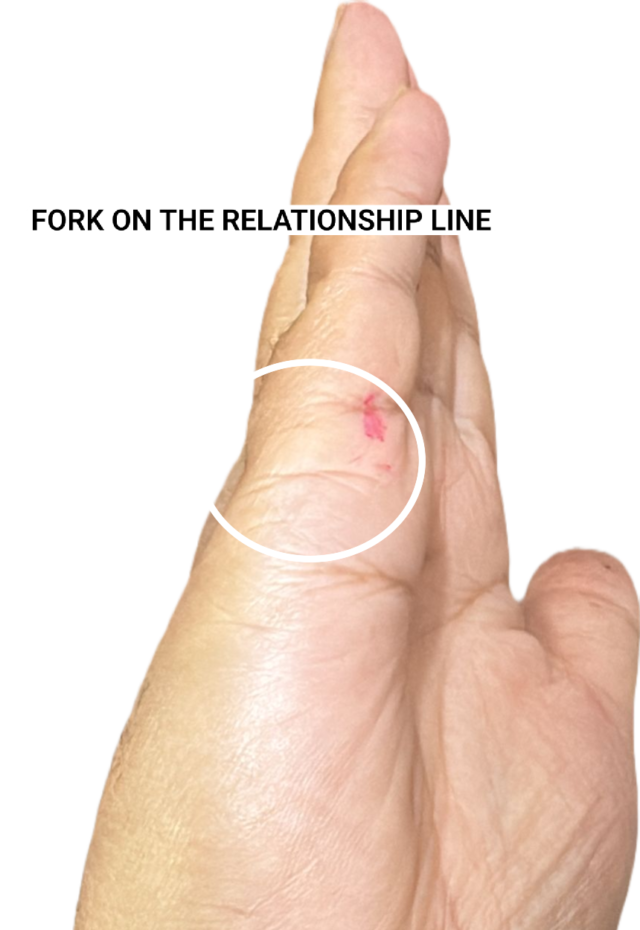
A fork tells you when the strain hits. A fork at the start of the line points to distance or differences in the early stage of the relationship — a bumpy beginning, two people finding their footing. A fork at the end points to the same thing arriving later on — growing apart, drifting, or differences that surface once the bond has aged. Same marking, different timing: read where it sits on the line to read when the friction comes.
The Relationship Line and the Rest of the Hand
Here’s what separates a real reading from a party trick: no line is read alone. Traditional palmists cross-check the relationship line against the heart line (how you love), the fate line (how partnership shapes your path), and more. The old texts describe fortunate combinations where clear, flawless lines connect across the palm as especially auspicious for love — and warn that faults appearing across several lines at once carry more weight than any single mark. One line is a word. The hand is the sentence.
About Those “Children Lines”…
You may read online that the tiny vertical lines rising off the relationship line predict how many kids you’ll have — and their gender. Handle this one with real skepticism. Even palmists who use the tradition admit these lines are hard to see and interpret, and modern choices about having children are far more complex than any palm line can capture. File it under folklore, not forecast.
Reading It Honestly
The relationship line is the most emotionally loaded line on the hand, which is exactly why it deserves the most level head. Palmistry is a centuries-old tradition of reflection and storytelling — not a prediction of your divorce, your wedding date, or your future partner. As one honest guide puts it, palmistry doesn’t forecast the future with total accuracy; it’s been used for centuries to understand relationship patterns and the nature of connection. The lines describe tendencies. The relationship is built by two people, with choices no palm can make for them.
So if you don’t love what you see, breathe. Don’t be upset if the line isn’t “ideal.” A line is a story so far — not a sentence.
Now Check Your Palm
Turn your hand to the light. How many lines do you see? Are they long or short, deep or faint, curving up in peace or down in passion? Any breaks that turned into comebacks?
Compare both hands, then read it alongside your heart line for the full picture of how you love. Tell us in the comments what your edge is hiding — and if you’re new to the series, go back through the life line, heart line, head line, and fate line to read your whole palm like a story.
Next in the series: The Sun Line — the palm’s mark of success, talent, and recognition.
___________________________________________________________________________
Western Palmistry shares traditional interpretations for reflection and entertainment. Palm lines are not medical, psychological, or relationship predictions.
