
Western Palmistry — Palm Lines Series
Here’s a palmistry fact that stops people cold: you might not have a fate line at all. The life line, heart line, and head line show up on nearly every hand ever born. The fate line? It’s optional. Some palms have a bold one carving straight up the middle. Some have a faint thread. Some have nothing there at all — and that blank space is one of the most misunderstood, and most reassuring, readings in the whole craft.
This is the line everyone wants to talk about, because it’s the line about your path — your career, your direction, your destiny. So let’s read it properly, with the real tradition behind it.
___________________________________________________________________________
Meet the Line of Saturn
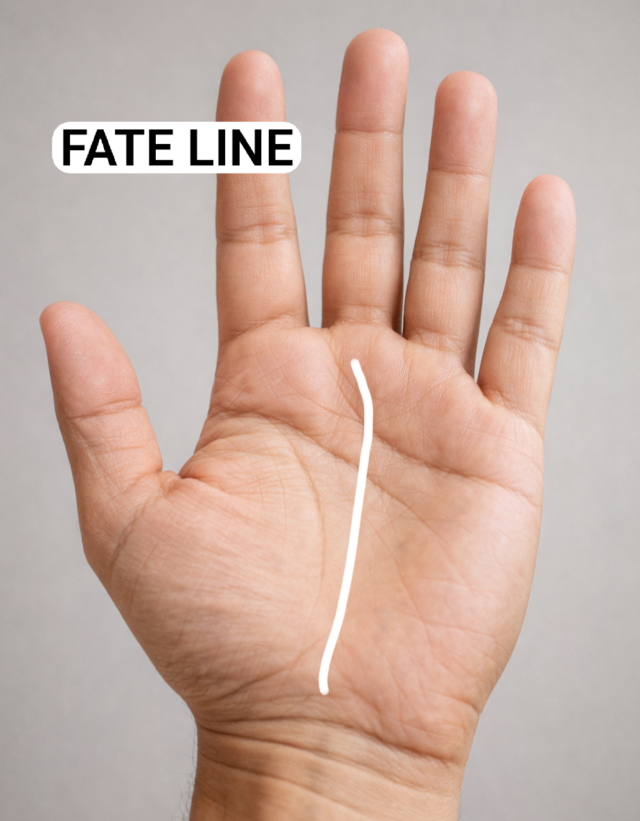
Open your dominant hand and look for a vertical line running up the center of your palm toward your middle finger. It usually begins near the wrist and moves upward toward the Mount of Saturn, just below the middle finger. That’s why its oldest name is the Saturn line — it also answers to destiny line, career line, luck line, and in Vedic palmistry, Bhagya Rekha.
It’s the odd one out among the major lines in a way that matters: it’s the only major line that runs vertically instead of horizontally. While the others cross your palm, this one climbs it — a path rising upward, which is exactly what it’s said to represent.
And here’s the detail that changes everything about how you should read it: unlike the life line or heart line, the fate line can change over time as your decisions, career choices, and circumstances evolve. Sit with that. The “destiny line” is the line that changes the most. We’ll come back to why that’s the most important thing on this whole page.
Where It Starts Is the Whole Story
Before anything else, a real palmist checks where the line begins, because the origin point rewrites the entire reading. Here’s what the tradition says, and each one is a different kind of life:
Starts at the wrist: direction shows up early. A clear calling or sense of purpose from a young age — you knew what you were about before most people did.
Starts from the life line (curving up out of it near the thumb): the self-made path. Success that’s earned through your own hard work rather than inherited wealth or family support — you may struggle in the early years, then rise on your own effort. The classic entrepreneur’s origin.
Starts from the middle of the palm: the late bloomer. Real direction arrives in midlife, often after years of wandering — and lands all the harder for the wait.
Starts from the head line: success built on the mind. A fate line beginning up near the head line indicates career momentum establishing later — often firmly in the 50s — achievement that comes through intellect, decisions, and thinking your way up.
Some hands carry more than one fate line, read as multiple currents running at once — the steady job beside the passion project beside the thing you’re quietly building on the side.
Reading the Line’s Quality
A deep, straight, unbroken line running clean to the Mount of Saturn is the textbook “strong” fate line. A deep, straight, long fate line reaching the Mount of Saturn points to a powerful ability to build and run your own career or path. The old texts are almost extravagant about it: eminent palmists held that if your fate line is in its finest form, then even if your other lines are faulty and weak, you can still attain massive success. One strong line, in this tradition, can carry a whole hand.
A faint line points to a path still finding its shape — a life where personal will matters more than any fixed track laid out for you.
When the Line Breaks
This is where people panic, and where they shouldn’t. Breaks are read by type:
A break where the line stops, then restarts alongside itself — a parallel overlap — is the good kind. It signals a change of career or a fresh start — you switch paths and begin a new one. Not a loss. A pivot.
A clean gap — the line stops and picks up later with space between — is read as the harder version: a period between chapters, a stretch of searching before the next path begins.
Islands (small ovals in the line) are read as periods where life doesn’t flow smoothly — stretches of pressure, strain, or being pulled off course.
Branches carry direction: shoots rising upward off the line are read as opportunities and achievements; lines falling away as detours and setbacks the path had to absorb. And a star at the very end of the line is considered especially auspicious.
The Palm With No Fate Line: The Reading That Scares Everyone (and Shouldn’t)
If you’ve searched your palm and found nothing running up the middle — read this part twice.
An absent fate line does not mean a life without direction. It’s one of the most misunderstood readings in all of palmistry, and far more common than most books admit. The real meaning is almost the opposite of doom: a missing fate line typically marks a self-directed soul — someone who builds their own path through conscious choice rather than following what feels like an invisible current.
Modern palmists say it even more plainly: the absence of a fate line is completely normal and does not indicate a lack of success or direction — many highly accomplished people have no visible one, and it simply means the career is self-directed, created by the person rather than handed to them by fate.
Now here’s the line that should end the panic forever. Classical palmists had a saying that sounds almost paradoxical: it is better to have no fate line at all than to have one full of breaks and gaps. A blank palm isn’t the booby prize. In the old reckoning, its absence means you achieve success through your own efforts rather than luck or destiny. No line handed to you means no script to follow — just the pen.
The Timing Trick
One reason the fate line fascinates career-minded people: palmists read it like a timeline. The line is divided by age, running from the base of the palm upward through the decades toward the Mount of Saturn. Using that map, a break around the mid-palm level, near the head line, is read as a major career change around the mid-30s. These ages are approximate and skilled readers calibrate to the individual hand — but it’s why someone can look at a stranger’s palm and say “something shifted for you around 35,” and land it.
The Detail That Proves It’s Not Fatalism
Here’s my favorite thing in the whole tradition, and it demolishes the idea that a palm line is a sentence. The classic texts freely admit the fate line is deeply subjective — that the same line means different things on different lives. Their own example says it best: an office cleaner who is genuinely happy and satisfied can carry a long, strong, clear fate line, while a stressed, frustrated bank president can carry a broken and weak one.
Read that again. The “better” line belongs to the contented cleaner, not the miserable executive. The fate line isn’t measuring your salary or your status — it’s measuring your alignment with your own path. Which means the line is describing a relationship between you and your life, not a fixed outcome stamped on you at birth.
Your Fate Line Was Read for a World That No Longer Exists
The old manuals were written for an era with exactly one script: get a job, keep it for forty years, retire. A deep, dead-straight fate line was the jackpot because a straight line meant a straight path — and a straight path was the only respectable kind.
That world is gone. Read the fate line through 2026 eyes and the meanings flip:
That “broken” line the old books frowned at is the most modern hand in the room. Three pivots, a layoff, a side hustle that became the main event — tradition called it instability; today it’s just a résumé. And notice the tradition already half-agreed: a break that restarts alongside itself was always read as a fresh career, not a failure. Every break is a plot twist.
No fate line? Welcome to the founder’s palm. The reading — a life chosen, not given — describes the freelancer, the creator, the founder almost too perfectly. The old palmists thought that hand was rare. They never met a generation that wakes up every day with no map and draws its own. As one 2026 reading notes, the fate line is now among the most asked-about features in palmistry, especially among professionals, entrepreneurs, and people at career crossroads.
Two or three lines crossing your palm? Not chaos — the portfolio life. The day job, the passion project, and the thing you do at 11pm that might change everything, all written into one hand.
Here’s the kicker the ancient readers understood before we did: they named it the destiny line, then admitted it changes faster than any other, that its absence sets you free, and that a happy cleaner beats a miserable president. Even a century ago, palmistry was quietly telling us the truth we’re still catching up to. Your path isn’t the boat you’re stuck in. It’s the current — and you’re holding the oars.
Reading It Honestly
One straight note, because this line invites overreach more than any other. Palmistry is a centuries-old tradition of reflection and storytelling — not a forecast of your career, your salary, or your net worth. No line guarantees success, and no missing line forbids it. Even the traditions that lean hardest on prediction agree on the punchline: the most effective way to “strengthen” your fate line is to take concrete action in the real world. The palm can pose the question. Only you answer it.
And the question the fate line poses is a good one to ask at any age: Am I walking a path someone else laid for me, or one I actually chose — and is it the one I want?
Now Check Your Palm
Do you even have a fate line? If so, where does it begin — the wrist, the life line, the middle of the palm? Is it one clean climb, a set of chapters broken and restarted, or gloriously absent?
Look at both hands, then step back and read all four major lines together — life, heart, head, and fate. Vitality, love, mind, and path, all in a single hand. That’s the whole portrait.
This wraps our core Palm Lines series. If you’re just arriving, go back through the wider life line, narrow life line, heart line, and head line — then read your whole palm like a story, beginning to end.
Tell us in the comments: do you have a fate line, or are you writing your own?
___________________________________________________________________________
Western Palmistry shares traditional interpretations for reflection and entertainment. Palm lines are not medical, psychological, or financial predictions.

One comment
Chen Wang-yuen | FaceSage
September 14, 2026 at 6:33 pm
The paradox that the “destiny line” is described as the line most able to change is the most compelling part of this explanation. Your distinction between an overlapping restart and a clean gap also shows how much traditional palmistry depends on fine visual details, not just whether a line exists.