
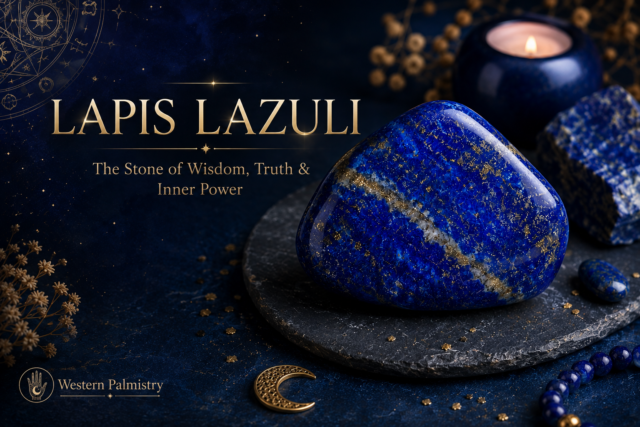
The deep blue crystal that pharaohs wore, Renaissance masters ground into paint, and modern seekers keep on their desks.
___________________________________________________________________________There’s a reason lapis lazuli has never gone out of fashion in 6,000 years. Hold a good piece up to the light and you’ll see it: an impossible midnight blue, veined with white calcite like cloud, flecked with golden pyrite that catches the light exactly like stars. Ancient cultures didn’t think that resemblance was an accident. They thought they were holding a piece of the night sky.
Whether you come to lapis as a collector, a jewelry lover, or someone building a crystal practice, it’s one of the few stones where the history is every bit as compelling as the mythology.
___________________________________________________________________________
What Lapis Lazuli Actually Is
Here’s a fact that surprises people: lapis lazuli isn’t a single mineral. It’s a rock — a naturally occurring blend of several minerals fused together.
- Lazurite — the star of the show, responsible for that saturated blue. The more lazurite, the deeper the color and the higher the value.
- Calcite — the white streaking and marbling. Heavy calcite lowers the grade commercially, though many people love the marbled look.
- Pyrite — the metallic gold flecks. In fine specimens these scatter like constellations. Pyrite also helps distinguish real lapis from dyed imitations.
The name itself is a small history lesson. Lapis is Latin for stone. Lazuli traces back through Latin and Arabic to the Persian lazhward, meaning blue — the same root that gave English the words azure and lazuli.
Hardness: 5–5.5 on the Mohs scale — soft. This matters enormously for care, which we’ll get to.
___________________________________________________________________________
A History Older Than the Pyramids
The mines that never moved
Nearly all the world’s finest lapis has come from one place for over six millennia: the Sar-e-Sang mines in the Badakhshan province of northeastern Afghanistan, high in the Hindu Kush. Miners were extracting stone there around 7,000 years ago, and they’re still extracting it today. Very few commodities on Earth have that kind of unbroken supply line.
Smaller deposits exist in Chile, Russia (Lake Baikal), Myanmar, Pakistan, and the United States — but Afghan lapis remains the benchmark.
Mesopotamia and the royal dead
Lapis appears throughout ancient Sumer. The Royal Tombs of Ur (c. 2600 BCE) yielded staggering quantities of it — beads, inlays, the famous headdress of Queen Puabi. In the Epic of Gilgamesh, lapis is the material of things divine and precious. It was a trade good moving thousands of miles by caravan long before anything resembling a road network existed.
Egypt’s sacred blue
The Egyptians were besotted with it. Lapis was ground into eyeshadow, carved into scarabs and amulets, and inlaid into the funerary mask of Tutankhamun, where it frames the eyes and stripes the nemes headdress. It was associated with the heavens, with divine favor, and with Isis and Ma’at — the goddess of truth, whose feather weighed hearts in the afterlife.
That connection to truth echoes down into every modern description of the stone.
Ultramarine: the pigment worth more than gold
This is the part that always lands. During the medieval and Renaissance periods, lapis was crushed and refined into ultramarine — literally “beyond the sea,” named for its journey from Asia. It was the most expensive pigment on Earth, priced above gold by weight.
Because it cost so much, artists reserved it for the most important subject in a painting: almost always the Virgin Mary’s robe. Patrons wrote the pigment into contracts by the ounce. Look at Vermeer’s Girl with a Pearl Earring — that headscarf is lapis. Titian, Michelangelo, and Fra Angelico all used it.
Synthetic ultramarine was invented in 1826, which democratized the color and ended lapis’s reign as a pigment. Its reign as a gemstone continued uninterrupted.
___________________________________________________________________________
Metaphysical Meaning: The Stone of Truth
In crystal traditions, lapis lazuli is consistently the stone of truth, wisdom, and honest self-expression. Not truth in a confrontational sense — more the quieter, harder work of being honest with yourself first.
Practitioners commonly associate it with:
Clear communication. The classic use. Lapis is reached for before difficult conversations, presentations, negotiations, and anywhere you need to say the real thing rather than the safe thing.
Inner truth and self-awareness. It’s said to surface what you’ve been avoiding — which is why some people find lapis intense at first. It isn’t a soothing stone so much as a clarifying one.
Intellectual clarity. A traditional stone of scholars, writers, students, and anyone doing sustained mental work. Often kept on desks and in studies.
Intuition and inner vision. Linked to dreams, insight, and perception beyond the obvious.
Emotional steadiness. Associated with releasing repressed anger and old resentment — particularly the kind that comes from never having said what you needed to say.
Chakra associations
Throat Chakra (Vishuddha) — its primary seat. Voice, expression, speaking truthfully.
Third Eye Chakra (Ajna) — intuition, insight, clarity of perception.
Working both together is why lapis is described as the bridge between knowing something and saying it.
___________________________________________________________________________
Zodiac Signs
Lapis lazuli is most strongly associated with:
♐ Sagittarius — the primary and most widely cited association. Sagittarius is the sign of the philosopher, the seeker, the blunt truth-teller. Lapis is a traditional Sagittarius birthstone (December), and the fit is natural: a stone of wisdom for the sign that chases meaning. It’s said to help Sagittarians temper bluntness into genuine insight.
♎ Libra — supports Libra’s search for balance and fairness, and helps counter the classic Libra tendency to smooth things over rather than speak plainly.
♒ Aquarius — resonates with Aquarian visionary thinking, originality, and truth-telling. Some traditions list lapis among Aquarius stones.
♑ Capricorn — often paired with Capricorn through the Saturn connection in Vedic practice, supporting discipline and long-view thinking.
♍ Virgo — occasionally cited for its clarity and analytical support.
Worth saying plainly: you don’t need a matching sign to work with a stone. These are traditional correspondences, not requirements.
___________________________________________________________________________
Planetary Associations
Jupiter is the most common Western association — planet of wisdom, philosophy, expansion, higher learning, and truth. This is entirely consistent with lapis’s reputation and with its Sagittarius link (Jupiter rules Sagittarius).
Venus appears in some Western traditions, connected to beauty, harmony, and relationship honesty.
Saturn dominates in Vedic astrology (Jyotish), where lapis is sometimes used as an affordable substitute for blue sapphire (Neelam), Saturn’s stone. Important caveat: traditional Vedic practice treats Saturn stones as powerful and situational, and reputable astrologers advise consulting a practitioner before wearing one long-term rather than picking it up casually.
Other correspondences:
- Element: Water (sometimes Air)
- Numerology: 3
- Day: Thursday (Jupiter’s day)
- Metal: Gold — which also happens to be how it’s most beautifully set
___________________________________________________________________________
How to Actually Use It
Wear it near the throat. Pendants and chokers are the traditional placement for the throat chakra connection. Rings and bracelets work too — just keep the softness in mind.
Meditate with it on the third eye. Lie down, place the stone on your forehead, and focus on breath. Ten minutes is plenty.
Keep it on your desk. A tumbled stone or small tower near your workspace, especially for writing, studying, or analytical work.
Carry it for hard conversations. A pocket stone before an interview, a performance review, a boundary you’ve been putting off. Even as pure psychological anchoring, it works — a physical object that reminds you what you decided to say.
Journal with it. Hold it while writing. Lapis is strongly associated with surfacing honest thoughts, and journaling is where that becomes practical.
Use it in the bedroom for dream work — but a note: some people find lapis too mentally stimulating for sleep. If your mind races, move it off the nightstand.
___________________________________________________________________________
Caring for Lapis Lazuli (Read This Part)
Lapis is soft and porous. It’s one of the easiest stones to accidentally ruin.
Do:
- Wipe with a soft, slightly damp cloth and dry immediately
- Store separately from harder stones like quartz to prevent scratching
- Put it on after perfume, lotion, and hairspray
- Cleanse with moonlight, sound, smoke, or by resting it on selenite or a bed of dry salt (not in it)
Don’t:
- Soak it in water, ever — prolonged water exposure damages the polish and can loosen the calcite
- Use salt water, which is worse
- Use ultrasonic or steam cleaners
- Expose it to household chemicals, acids, or bleach
- Leave it in harsh direct sunlight for long stretches, which can fade the blue.
___________________________________________________________________________
How to Spot Fake Lapis
The market has plenty of imitations. A few checks:
- Look for pyrite. Real lapis usually has irregular, scattered gold flecks. Uniform glitter suggests synthetic.
- Uneven color is a good sign. Perfectly flat, uniform blue with no variation often means dyed howlite, dyed jasper, or reconstituted material.
- The acetone test. A cotton swab with acetone on an inconspicuous spot: dye lifts off, real lapis doesn’t.
- Weight and temperature. Genuine lapis feels dense and cool. Plastic feels light and warms up fast.
- Price honesty. Deep, even, pyrite-flecked Afghan lapis is not cheap. If a large “AAA grade” piece is priced like a keychain, it isn’t.
Watch for the terms “denim lapis” (genuine but pale, heavily calcited — legitimately sold and often lovely) and “Swiss lapis” or “Spanish lapis” (dyed jasper, not lapis at all).
___________________________________________________________________________
The Takeaway
Lapis lazuli is the rare stone where you don’t have to choose between the metaphysical and the historical to find it meaningful. Even setting every energetic claim aside, you’re holding a mineral that traveled from Afghan mountains to Sumerian tombs, framed the eyes of a boy king, and became the blue of the Virgin’s robe in the greatest paintings in Europe.
And if you do work with crystals, its meaning has stayed remarkably consistent across every culture that touched it: truth, wisdom, and the courage to say what’s real.
That’s not a bad thing to keep in your pocket.
___________________________________________________________________________
A gentle note: crystal healing is a traditional and spiritual practice, not a scientifically validated medical treatment. Lapis lazuli is a beautiful companion for reflection, focus, and intention — but it isn’t a substitute for professional medical or mental health care. Please see a qualified practitioner for any health concern.
