
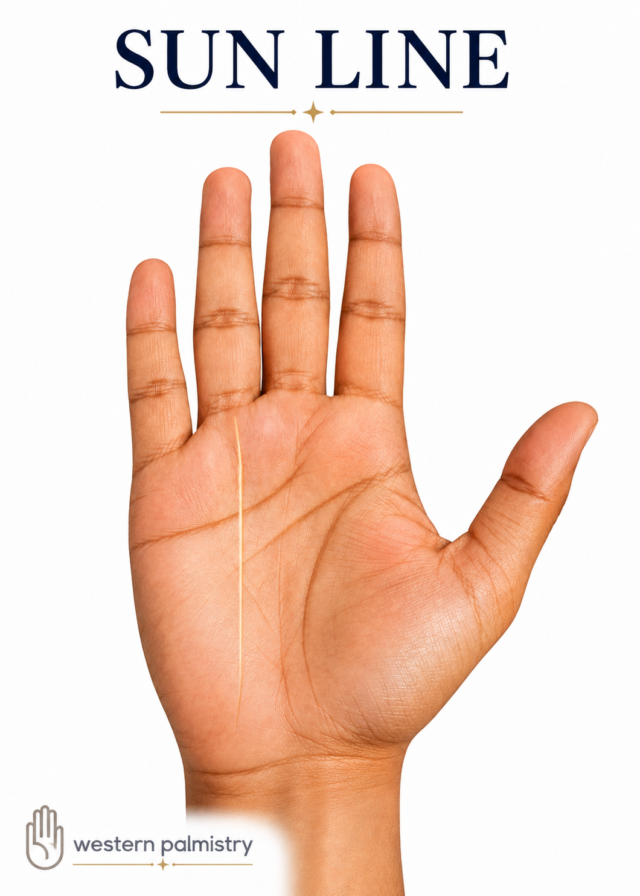
There is a line on the hand that almost nobody asks about by name, and almost everybody asks about by feeling.
They sit down, turn their palms up, and say some version of the same thing: Will it ever come together? Will anyone notice? Am I building something, or just staying busy?
That question lives in the Sun Line.
Also called the Apollo Line, the Line of Success, or — in the older, more romantic manuals — the Line of Fame, the Sun Line is one of the most misunderstood marks in palmistry. It is not a guarantee of wealth. It is not a celebrity detector. After thirty years of turning hands toward the window, I’ve come to read it as something subtler and far more useful: the line of recognition — including self-recognition. It shows whether your inner light has found an outlet.
Let me show you how to find it, and how to read it honestly.
___________________________________________________________________________
Where the Sun Line Lives
Look at your dominant hand under good, natural light. Find the ring finger — in palmistry, the Apollo finger. Now drop your eye straight down to the fleshy pad beneath it, just above the heart line. That cushion is the Mount of Apollo.
The Sun Line is any vertical line that rises up the palm and terminates on that mount.
Two things to know before you start hunting:
It is often faint. The Sun Line is rarely as bold as the life, head, or heart lines. Many strong Sun Lines are hairline-fine. Faint does not mean weak — it means fine-grained.
It is often short. The classic Sun Line appears only in the upper third of the palm, running from around the heart line up to the mount. This is completely normal and, in fact, the most common form.
Tilt the hand. Flex the fingers slightly. Lines hide in flat light.
___________________________________________________________________________
The First Question: Where Does It Begin?
The origin of the Sun Line tells you the source of a person’s shine. This is where reading gets interesting, because the same line means different things depending on where it takes its root.
From low in the palm, near the wrist. Rare, and striking. This is the mark of someone whose gift announced itself early and never really left. Artists who drew before they could write. The risk here is the gift becoming the whole identity.
From the Mount of Luna (the pad on the outer edge, below the little finger, toward the wrist). My favourite origin to find. Luna governs imagination, the unconscious, and the response of other people. A Sun Line rooted here suggests success that comes through others — an audience, a public, a community. Performers, writers, teachers, anyone whose work only completes itself when it’s received.
From the Life Line. Success built on personal effort and family foundation. Nothing handed over. This person’s shine is earned in daylight, hour by hour.
From the Fate Line. The career and the calling are the same thing. Beautifully simple. Slightly precarious — when the work wobbles, the whole self wobbles.
From the Head Line. Recognition arrives through intellect, strategy, or craft, and it usually arrives after thirty-five. A late-blooming line, and often a durable one.
From the Heart Line. The most common origin of all. Success in the later chapters, powered by relationships, mentorship, and emotional maturity. If you’re reading your own palm at forty and find your Sun Line starting here, you have not missed anything. You’ve arrived on schedule.
___________________________________________________________________________
Reading the Line Itself
Once you’ve found the root, read the body of the line for four qualities.
Clarity. A single, unbroken, clean line is the strongest form — focused talent with a clear channel to the world. Read it as a well-made pipe.
Depth. Depth speaks to intensity, not virtue. A deeply etched Sun Line belongs to someone for whom recognition genuinely matters. That drive builds careers; it also builds a hunger that applause never quite fills.
Length. Longer lines suggest recognition sustained over a longer stretch of life. Short does not mean small — a two-centimetre line above the heart line can indicate a decade of deserved acclaim.
Number. Two or three parallel Sun Lines are a classic sign of multiple talents. Genuinely gifted people often have them. So do genuinely scattered ones. If you find three fine lines and no dominant one, the reading is nearly always the same: the talent is real, the focus isn’t yet. Choose one. The lines will follow.
___________________________________________________________________________
Markings, and What They Actually Mean
Traditional palmistry loves a dramatic symbol. I’d ask you to read them as weather, not verdicts.
A star on the Mount of Apollo — the most celebrated mark in all of palmistry. Sudden, sometimes overwhelming recognition. In practice, I read it as a moment that changes the scale of your life. What you do with the scale is your business.
A square — protection. Reputation survives a scare. A very reassuring mark to find on a Sun Line that also has a break.
A break — an interruption in recognition: a career pivot, a project that stalled, a season out of view. Look at what comes after. Breaks that overlap are transitions; breaks that leave a gap are pauses.
An island — a stretch of divided energy. Often shows up during periods of doing good work under a name or brand that isn’t your own.
A fork at the top (the trident) — the most auspicious ending. Traditionally read as fame, wealth, and fulfilment together. I read it more modestly: the talent found more than one door.
A grille or crosshatching — scattered energy, or applause pursued for its own sake. The classic caution mark of the Apollo mount.
___________________________________________________________________________
When There Is No Sun Line At All
This is the moment in a reading when someone’s face falls, so let me be direct.
A missing Sun Line is not a missing life. I have read the hands of extraordinary people — surgeons, mothers, craftsmen, engineers who quietly hold cities upright — with no Sun Line whatsoever.
The Sun Line is not the line of worth. It is the line of visible fulfilment. Its absence most often means one of three things: the work is done out of public view; the recognition matters less to this person than the doing; or the light hasn’t found its channel yet.
That last one matters, because here is the part that surprises people most:
The Sun Line changes. Of all the lines on the hand, it is among the most mutable. I have watched faint Sun Lines deepen over five years in people who finally started the thing they’d been circling. I have watched them appear where there were none. The hand is not a sentence handed down. It’s closer to a mirror that updates slowly.
___________________________________________________________________________
A Reading You Can Do Tonight
Take ten minutes and both hands. Read the non-dominant hand for what you were given; the dominant hand for what you’ve made of it.
Ask three questions in order:
Where does it start? — What is the source of my shine?
What is its condition? — Clear, forked, broken, multiple?
What has changed between my two hands? — This is the real reading. A stronger Sun Line on the dominant hand means you’ve built something with what you were handed. A weaker one is worth sitting with.
Then put the manual down and be honest with yourself about what the third answer means.
___________________________________________________________________________
A Palmist’s Closing Note
Palmistry is a symbolic tradition, not a science — a language for looking at a life sideways, the way a good poem gets at something a report can’t. I’d never ask you to hand it a decision that belongs to you.
But I’ll say this after a decades and a half of hands: the people with the strongest Sun Lines are almost never the ones chasing the light. They’re the ones who found the work that made them forget to check whether anyone was watching.
The recognition, when it came, came second.
It usually does.
___________________________________________________________________________
Western Palmistry shares traditional interpretations for reflection and entertainment. Palm lines are not medical, psychological, or financial predictions.
