
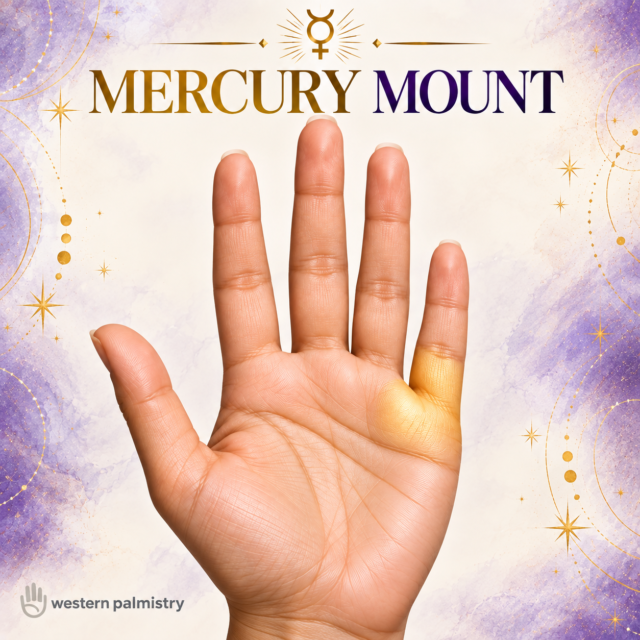
It’s the smallest mount on your hand and it punches far above its weight.
Find it: the little cushion under your little finger, just above where your heart line begins. That’s the Mount of Mercury, and it governs the fast-moving parts of a person — speech, wit, quickness, persuasion, trade, and the kind of cleverness that reads a room in four seconds.
In the old system, Mercury was the messenger god. He handled language, commerce, travel, and negotiation. He was also, notably, the trickster. Both of those live in this mount, and telling them apart is most of the skill.
Here’s how to read yours.
___________________________________________________________________________
Step One: Press It
Palm up, good light. Press the pad beneath your little finger.
Full and firm. Mercury is live. Quick-witted, persuasive, funny, good with words or numbers or both. This person is rarely lost for a reply, and often ends up being the one who explains things to everyone else.
Flat. Quieter Mercury. Often someone who knows exactly what they mean and finds it genuinely effortful to hand it over. Not a lack of intelligence — a lack of an easy channel. If you have a flat Mercury and a strong head line, that gap between what you think and what comes out is real, and it’s worth knowing it isn’t a flaw in you.
Puffy and soft. Full of Mercury’s qualities with nothing anchoring them. The old texts go straight to cunning here. I’d put it differently: quickness without ballast. Very persuasive, sometimes before they’ve decided what they actually believe.
___________________________________________________________________________
Step Two: Which Way Does It Lean?
Look at the fine skin ridges under strong light. They converge to a point, and where that point sits shifts the whole reading.
Centred under the little finger. Mercury straight up. Communication and commerce expressed directly.
Leaning toward the ring finger (Apollo). Words with warmth. Storytellers, teachers, marketers, people who make information enjoyable. Probably my favourite placement on this mount.
Leaning toward the outer edge of the hand. Blunter, more independent, less interested in charming anyone. Says the true thing, and doesn’t dress it.
___________________________________________________________________________
Step Three: The Little Finger
This is where the real information is, and most guides skip it.
Length. Hold your hand relaxed and look at where the little finger reaches against the ring finger. If it passes the top crease of the ring finger’s first joint, it’s long — articulate, persuasive, quick with language and numbers. Falling well short of that crease is short, and points again to that gap between thought and expression.
Set. This is the detail worth learning. Look at where the little finger joins the hand compared to the other three. If it sits noticeably lower — dropped into the palm rather than level — the entire Western tradition reads it the same way: early disadvantage, a harder start, something that had to be overcome.
I take this one seriously. When I find a low-set little finger, I read everything else on this side of the hand more gently, and I usually find there’s a story there worth asking about.
Which section is longest? Top section points to speech and expression. Middle points to business and science. Bottom, nearest the palm, points to practical trade and a materialist streak.
___________________________________________________________________________
A Word About Bent Little Fingers
The old books say a crooked or twisted little finger indicates dishonesty.
I don’t read it that way, and I’d ask you not to either.
A curved little finger is an extremely common physical variation — plenty of people simply have one, and it says nothing whatever about their character. Where a lean is meaningful, it’s a slight tilt toward the ring finger, which the tradition reads as tact and diplomacy, and only at its extreme as a willingness to shade the truth to keep the room comfortable.
Even then, read it against the whole hand. Never call someone dishonest on the strength of one finger. That’s how palmistry earned its worst reputation.
___________________________________________________________________________
The Good Signs
The medical stigmata. Three or four short vertical lines on the mount, standing parallel like a tiny fence. The classic healing mark — nurses, doctors, therapists, vets, carers. This is one of the few signs in palmistry I’ve found holds up with real frequency across hundreds of hands. If you have it and you’ve never worked with people, it’s worth asking what that capacity has been doing instead.
A triangle. Aptitude for science, diplomacy, or negotiation. Cleverness with structure behind it.
A single clear vertical line. Focus. One strong line beats five faint ones.
A square. Protection — a reputation or a business that came through a rough patch intact.
A clear line arriving on the mount from lower down the palm. That’s the Mercury Line, and it deserves its own reading entirely. Depending on its condition it’s known as both the Health Line and the Business Line, which sounds like a contradiction and isn’t.
___________________________________________________________________________
The Difficult Signs
Weather, not verdicts.
A grille — a tight crisscross mesh. The traditional books read this as cunning and deceit. That’s harsher than I’d put it. I read a grille here as restless cleverness with no outlet — a quick mind spinning without traction, which can slide into sharp practice mostly out of boredom.
A cross. Traditionally another dishonesty mark. Same reservation. I’d read it as a communication that went badly wrong somewhere, and I’d want corroboration elsewhere on the hand before saying more.
Lots of scattered fine lines. Restlessness. Many conversations, many schemes, nothing finished.
An island. A period where words or business were working for someone else’s benefit.
___________________________________________________________________________
Read Yours in Five Minutes
- Press the mount. Full, flat, or puffy?
- Find the lean. Toward Apollo, toward the edge, or centred?
- Check the little finger. Length, set, and any lean.
- Look for the good marks first. Medical stigmata, triangle, clear line, square.
- Then the difficult ones.
- Compare both hands. The hand you don’t write with is what you were given. The one you write with is what you’ve made of it. A Mercury mount that’s stronger on your writing hand usually means you learned to speak up somewhere along the way. That’s not nothing.
___________________________________________________________________________
Before You Go
If you’ve found a grille, or a cross, or a low-set finger and felt a bit accused — put that down.
The older literature was rough on this mount and it was wrong to be. Nothing on your palm makes you dishonest, and nothing on it caps what you’re able to say, sell, build, or explain.
What this mount is genuinely good for is a single question:
Is my quickness going anywhere useful?
For most people with a strong Mercury, the honest answer is some of it. That’s a better place to start than any warning mark.
___________________________________________________________________________
Palmistry is a symbolic tradition, not a science. Nothing here predicts the future, diagnoses illness, or limits what you’re capable of. For health, money, or legal matters, please talk to a qualified professional.
