
A working reading, in the Western lineage
I want to start by telling you how a Mercury Line reading really goes, because it isn’t how the popular posts describe it.
Someone sits down. They turn their hands over. And I don’t look at the Mercury Line.
I look at the little finger — its length, where it’s set into the hand, whether it leans. I look at the pad beneath it. I look at the colour of the palm, the texture of the skin, how the hand yields when I press the mount. I look at the shape of the whole hand and decide what kind of hand I’m holding.
Only then, five or six minutes in, do I go looking for the diagonal.
That order isn’t ceremony. It’s the difference between a reading and a horoscope. The Mercury Line means almost nothing on its own — it is a modifier, and you cannot modify something you haven’t established. So let me teach it the way it’s actually practised: from the mount up.
___________________________________________________________________________
First, an Argument Worth Knowing
The line running diagonally toward the Mount of Mercury has at least five names, and the disagreement is instructive.
Cheiro called it the Health Line and read it fairly directly — a register of the constitution, with the classic warnings attached.
William Benham, whose Laws of Scientific Hand Reading (1900) remains the most rigorous Western text we have, disliked that name intensely. He insisted on Hepatica, arguing that the line reflects the liver and digestive apparatus specifically, and that calling it a “health line” invited exactly the sloppy fortune-telling he’d spent a career trying to dislodge from the subject.
Saint-Germain and the older French tradition folded it into the mercantile reading — the Business Line, a mark of commercial quickness.
They’re not describing different lines. They’re describing different confidences about what a line can tell you. Benham was the most cautious of the three, and Benham is the one I’d follow.
___________________________________________________________________________
Step One: The Mount of Mercury
Press the pad beneath the little finger, just above the heart line’s origin.
Full and firm — the Mercury qualities are live: quickness, commerce, speech, adaptability, science, wit. Everything the line says afterward gets amplified.
Full but soft, spongy — the qualities are present but ungoverned. In the old texts this is where the shadow of Mercury sits: cleverness without ballast. Read the head line before you decide how much weight to give that.
Flat or deficient — Mercury is quiet in this person. A strong Mercury Line on a flat mount is a curious finding: energy with nowhere obvious to arrive. I take it as unexpressed capacity rather than a contradiction.
Vertical lines on the mount itself (the “medical stigmata” — three or four fine parallel lines) — the classic healing-professions mark. Nurses, therapists, veterinarians. This is one of the few marks I’ve found holds up with real frequency across hundreds of hands.
___________________________________________________________________________
Step Two: The Mercury Finger
Now the finger, because it reframes everything on the mount.
Length. Measure against the ring finger. A Mercury finger reaching past the top crease of the Apollo finger’s first joint is long — articulate, persuasive, quick with language and numbers. Falling well short is short: the person who knows what they mean and struggles to hand it over.
Set. This is the detail beginners skip and it may be the single most informative thing on this quadrant of the hand. A Mercury finger set noticeably lower than the other three — dropped into the palm — is read across the entire Western literature as a mark of early disadvantage, a struggle for footing, something that had to be overcome. When I find a low-set Mercury finger, I read everything else in the region more gently, and I usually find there’s a story there.
Lean. A little finger that curves toward Apollo suggests diplomacy — or, pushed further, a willingness to shade the truth to keep the room comfortable. Read it with the honesty of the whole hand, never alone.
___________________________________________________________________________
Step Three: What Kind of Hand Is This?
D’Arpentigny gave us the seven types; Benham refined them. You don’t need the full system, but you do need the question, because the same line means different things on different hands.
A chained, troubled Mercury Line on a nervous or psychic hand — fine skin, slender fingers, a hand that registers everything — is close to expected. It’s telling you about a sensitivity you already established from the texture and the fingers. It is barely news.
The identical line on an elementary or square hand — thick skin, blunt fingers, robust build — is genuinely arresting. Something is out of character with the constitution. That is a finding.
This is the discipline that separates practice from parlour work: a mark is only significant to the degree it surprises the hand it sits on.
___________________________________________________________________________
Now — Finding the Line, and Not the Wrong One
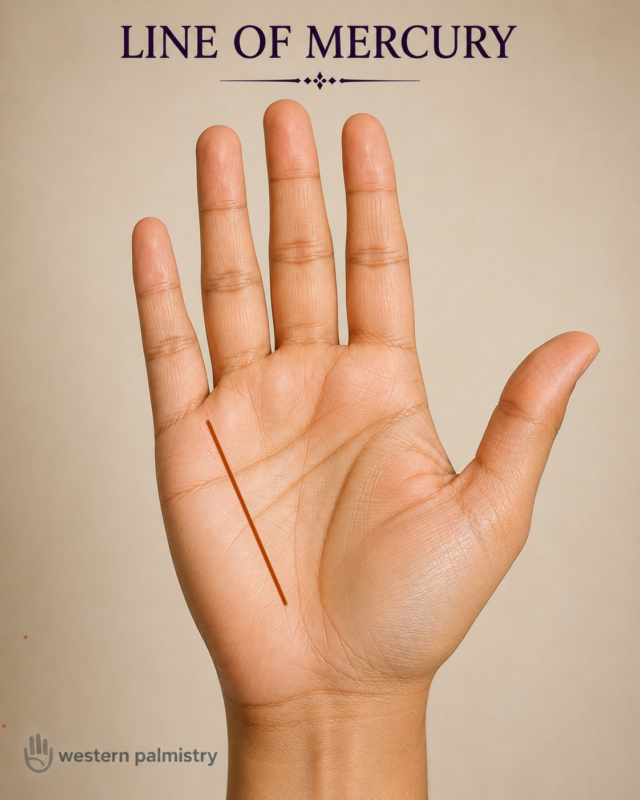
The Mercury Line rises low in the palm and travels upward and diagonally toward the Mount of Mercury. It usually roots near the wrist, on the Mount of Luna, or against the life line.
Three lines share this territory, and misidentification is the commonest beginner error:
The Line of Intuition. Curved — a distinct crescent bowing outward toward the percussion (the outer edge of the hand). If it arcs like a bow, it isn’t the Mercury Line.
Via Lasciva. This is the one that actually catches people. It also runs from the Luna region toward the Mercury side, but it sits lower and runs more horizontally, often below and roughly parallel to where a Mercury Line would travel. Traditionally read as sensual excess; in modern practice most readers use it as the allergy or sensitivity line — reactivity to substances, stimulants, medication. If you have mistaken Via Lasciva for a troubled Mercury Line, you will produce a health reading out of thin air. Check the angle before you say a word.
The line is genuinely absent. Common. See below.
___________________________________________________________________________
Reading the Line
Deep, straight, unbroken. The Business Line reading is live. With a long Mercury finger and a good head line, this is one of the more dependable commercial-instinct signatures on the hand.
Wavy. Irregular throughput — energy that answers to circumstance rather than to will.
Chained or laddered. Chronic low-grade depletion. Almost always situational in my experience, and among the more mutable marks on the hand.
Broken. Interruption. Overlapping fragments read as transition; clean gaps read as pause.
Islanded. Divided energy across a defined stretch. Benham read islands here against the digestive apparatus; I read them as periods when the body was carrying something unresolved.
Crossing or cutting the life line. The traditional caution point — and the place where irresponsible palmistry does its damage. It marks a juncture where vitality and self-monitoring collide. It is a prompt, not a prognosis, and I will say more about that at the end.
___________________________________________________________________________
Timing
Nobody explains this, so here it is.
Timing on the Mercury Line is read against the life line, not on its own scale. Take the life line as your clock: trace where the Mercury Line’s break, island, or crossing sits relative to the life line’s corresponding point, and read the age from there.
Two honest caveats. First, timing methods vary between schools and none of them are precise — treat any age you derive as a decade, not a year. Second, timing a health mark is where this practice is at its most speculative and its most potentially harmful. I use it to locate the past. I don’t use it to forecast.
___________________________________________________________________________
The Absence Question
A hand with no Mercury Line at all is common and, in the traditional reading, favourable: a constitution that simply proceeds without needing to be consulted.
Here I want to flag that I depart from the tradition. What follows is my own reading, not doctrine, and you should weigh it as such.
I don’t think absence indicates a robust body. I think it indicates an unexamined one. In my practice, the people with no Mercury Line are frequently the ones who have never once thought about their own pace — which serves them beautifully until the day it doesn’t. And the strong, clear Mercury Line so often belongs to someone highly attuned to their own machinery: aware of the stomach tightening before a hard conversation, aware of energy as a budget rather than a given.
That awareness is a real gift and a real tax. Benham would not have put it that way. I’m telling you it’s mine so you can disagree with it.
___________________________________________________________________________
The Reading, In Order
If you take nothing else, take the sequence:
- Mount of Mercury — developed, soft, flat? Any medical stigmata?
- Mercury finger — length, set, lean.
- Hand type — what is normal for this constitution?
- Locate the line — and confirm it isn’t Via Lasciva or the Line of Intuition.
- Read its condition — clarity above all.
- Read it against steps 1–3. Does it fit the hand or contradict it?
- Compare both hands. Non-dominant for what was given, dominant for what’s been made of it.
- Step six is the reading. Everything before it is preparation.
___________________________________________________________________________
The Part I Won’t Soften
Palmistry is a symbolic tradition. It does not diagnose, it cannot detect disease, and no mark on your hand carries clinical information.
A chained Mercury Line is not evidence of a liver condition. A break is not a warning. A line touching your life line at what you calculate to be age forty-eight tells you nothing whatsoever about age forty-eight.
If something in your body has been asking for your attention, the correct response is a doctor — today, not after you’ve finished squinting at your palm. I’ve watched people postpone appointments over marks on their hands, and I’d rather lose a reader than contribute to that.
What this line can legitimately do is make you sit with a question most of us avoid: have I been treating my energy as infinite?
That’s a fair thing to ask a hand. It’s the only health question I think a palm can honestly hold.
___________________________________________________________________________
Note on lineage: this reading follows the Western tradition — Benham, Cheiro, Saint-Germain. Hast Samudrika Shastra maps this region of the palm on quite different principles, and where the two traditions disagree, I haven’t tried to reconcile them here.
